


Innovation of Asymmetric Boring Tool Driven by Innovative Thinking
Release time:
2019-09-17
High precision boring is the key process of many important parts processing. The accuracy and roughness of the multi-journal crankshaft hole in the engine body are directly related to power output and fuel efficiency, and the processing time of the crankshaft hole is also directly related to the benefits of the engine manufacturing company. The quality of high-precision holes on a variety of mechanical parts plays a key role in achieving part performance indicators. These bores must meet critical tolerance requirements, but the problem is that high-precision boring is expensive and time-consuming; small mistakes can lead to the scrapping of expensive parts. Kennametal has therefore introduced a simple, asymmetrical straight
High-precision boring tools with innovative ideas can increase productivity and reduce processing costs
High precision boring is the key process of many important parts processing. The accuracy and roughness of the multi-journal crankshaft hole in the engine body are directly related to power output and fuel efficiency, and the processing time of the crankshaft hole is also directly related to the benefits of the engine manufacturing company. The quality of high-precision holes on a variety of mechanical parts plays a key role in achieving part performance indicators. These bores must meet critical tolerance requirements, but the problem is that high-precision boring is expensive and time-consuming; small mistakes can lead to the scrapping of expensive parts. Kennametal therefore introduced a simple shape, asymmetric linear boring bar tool, this innovative product is widely welcomed by users.
By definition, there is a difference between boring and drilling; boring is a process in which the inner diameter is directly related to the center line of the spindle. In this machining process, the most common is that the workpiece is clamped and in a static state, and the cutting tool enters the workpiece under rotation; boring machining can also be carried out during the adjustment of the tool and the workpiece.
The most common types of applications for boring include core holes, punching, drilling, and enlarging and finishing of internal profile surfaces. In some cases, the processing performed simultaneously with the boring processing also includes turning processing, end face processing, chamfering processing, grooving processing, and threading processing.
Kennametal's latest asymmetric linear boring tools can improve machining stability, machining speed, and boring quality, and reduce maintenance and application costs.
How to complete the machining process
Imagine that in a small engine block, a crankshaft bore for five linearly aligned journals needs to be machined. A regular option for multi-neck crankshaft hole finishing tasks is, for example, to use a multi-blade reamer with guide pads and follow the following procedure (named here as option 1.0):
-Finish the first journal with a guide reamer.
-Insert a multi-blade reamer to complete the semi-finishing and finishing of the second to fifth journals.
-Then remove the reamer.
The advantage of this machining process is that CNC horizontal machine tools or multi-axis machining centers can be used to complete the machining without using professional boring machine equipment with special fixtures. However, depending on the size of the workpiece, the machine tool must have sufficient rigidity, otherwise it will lead to a significant reduction in processing quality. In addition, the reamer's advance and retreat operations must be slow and precise in the bore after machining, otherwise it will cause back-out scratches or damage to the cutting edge.
A common alternative to complete this boring process is straight line boring (alternative 2.0). The basic problem to be solved by this option is how do the cutting edge and the tool guide pad pass through the smaller bore hole on the unfinished machining journal?
In order to solve this dilemma, CNC machine tool manufacturers use regular linear boring bar tools and the "opposite bearing frame" function on the equipment. This process is roughly as follows:
-The workpiece part on the machine tool raises the cylinder block
-The linear boring bar can be inserted into the bearing frame located at the other end through the workpiece
-The cylinder block is adjusted downward and clamped
-Semi-finishing and finishing of connecting rod holes
-The cylinder block is raised up and the boring bar is withdrawn
In this process, because the tool is supported at both ends, it can speed up the feed and exit operations; compared with the reaming option 1.0, the geometry and quality of the machined hole has been improved. The disadvantage is that the rising function requires a special fixture and CNC control system, and the fixture needs to support the opposite bearing frame, which makes the back part of the workpiece can not be any processing.
Multi-axis machine tools with inclined worktable and inclined spindle, and require more use of boring bar processing is more conducive to the choice of linear boring options 2.1, in this program need to use the expansion of the guide pad, the processing process is as follows:
-Finish the finishing of the fifth journal with a guide reamer
-Parts (or machine table) rotate 180 degrees
-Adjust the X-Y shaft of the machining center, the boring bar can be inserted in the eccentric position
-The boring bar with guide pad is inserted into the center of the fifth journal
-Guide pad expansion
-Semi-finishing and finishing the first to fourth journals
-Insert the guide pad again
-Boring bar exits at eccentric position
The optional scheme 2.1 applies the multi-axis machining adjustability of the machine tool. This scheme retains the advantages of the 1.0 scheme, does not need the rising function and the opposite bearing frame in the 2.0 scheme, and does not need to support the two ends of the tool. The disadvantage is that the mechanical device inside the boring bar is complex, the cost is high, and the use is difficult. Insufficient lubrication can cause damage to internal sensitive mechanical parts, and if not closely monitored, it may cause the tool to jam or hook in the workpiece, and cause damage to the machine tool, fixture, tool and workpiece.
Asymmetric products
In the process of working with a large automobile manufacturer to process cylinder blocks, Kennametal's technicians introduced an alternative to boring 3.0-asymmetric linear boring. This is a huge technological advance, highlighting the advantages of reaming and straight line boring, which can almost completely avoid the disadvantages of the above two schemes.
Like most advanced products, the basic principle is very simple. The normal guide diameter consists of three or more guide pads, which are tightly attached to the hole wall when entering and retreating, and there is no free gap. The guide pad of Kennametal products is similar to a typical guide bar reamer when set up, but the guide pad is usually located at 180 degrees of the cutting edge and is rotated to ensure that it can freely enter and exit the guide site, even through the original hole. This geometry allows the boring bar to operate in an eccentric trajectory in the original hole. The machining process is roughly as follows:
-Finish the finishing of the fifth journal with a guide reamer
-Parts (or machine table) rotate 180 degrees
-The asymmetric boring bar is fed in an eccentric position through the X-Y shaft of the machining center
-The tool is moved to the center part, and the finishing machining of the first journal to the fourth journal is completed at the same time
-The tool retract quickly in the eccentric position.
This asymmetric linear boring tool retains all the advantages of the previous linear boring tool-high-quality precision boring, support at both ends of the tool, no costly rise function, no need to hinder the processing of the opposite bearing frame and the key device inside the tool. In addition, in the traditional machining center, can also be a higher feed rate to complete the advance and retreat operation, thereby improving the processing efficiency.
Of course, as a product of Kennametal, the indexable insert product provided with this eccentric boring bar also uses advanced technology. The high-precision RI8 insert has eight cutting edges and a pre-determined inverted cone design, so it can be machined with high feed rates. The diameter can be adjusted to 1 micron accuracy level. The large clamping force provided by the tapered clamping screw avoids problems caused by unstable clamping.
The design of the blade device and the asymmetric boring bar ensure the stable clamping of the blade on the boring bar. This avoids the need for a tool holder and therefore the need for extra tolerances and space.
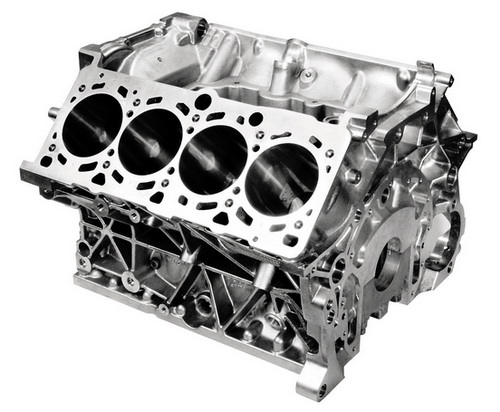
Cylinder block machining is an excellent example of the necessity and efficiency of high-precision linear boring tools in this type of machining.
Sidebar-Kennametal is nominated for the BMW Group Supplier Innovation Award
In December 2014, Kennametal announced that the company, along with three other suppliers, had won the 2014 BMW Group Supplier Innovation Award in the Product Category.
Among the three suppliers nominated for this award, Kennametal is the only manufacturer of cutting tool products. In the cooperation with BMW Group for more than 30 years, Kennametal has been recognized for its innovative spirit. Among the many reasons for its recognition, the BMW Group specifically mentioned the contribution of Kennametal's innovative tool products to the improvement of engine block processing efficiency at the BMW Group's plant in Steyr, Austria. Kennametal has set up a product design team to work with the BMW Group to develop this tool product that greatly improves processing efficiency.
At the BMW Group Supplier Awards Conference, Kennametal stood out from more than 200 suppliers to receive this recognition. We are very honored, said Gérald Goubau, Vice President and General Manager of the Tool Business Department of Kennametal.» This is a great recognition of our work, and it also reminds us of our mission to provide customers with innovative products and create greater value; this is also our daily goal.»
The BMW Group believes that the spirit of innovation is the foundation of the company's economic success and future competitiveness. The only way to meet the challenges of the automotive industry of the future is to promote the spirit of innovation and increase creativity. Therefore, the BMW Group regards the most innovative suppliers as important partners; these suppliers will play a key role in the successful implementation of the latest product development in the BMW Group. Vendor Innovation Awards are designed to recognize their contributions.
As an industry leader, Kennametal, celebrating its 75th anniversary, provides innovative product solutions to help customers increase productivity especially for customers seeking optimal product performance under harsh processing conditions. Kennametal applies the most advanced materials technology to provide innovative wear-resistant products, product and application design, and application technology for customers in 60 countries involved in aerospace, road construction and mining, energy, and industrial production. service. The company employs about 14,000 people and has total sales of nearly $3 billion; half of the company's revenue comes from markets outside North America; and sales of new products launched in the past five years account for 40% of global sales. Kennametal pays attention to the safety concept and has won the title of "the world's most ethical enterprise" (ethical village association), the title of "outstanding innovative enterprise" (product research and development management association), and the title of "America's safest enterprise" (EHS Today magazine); Kennametal and its foundation continue to invest in the fields of technical education, industrial technology and materials science, shows the development of the industry and the charm of economic prosperity prospects.
Related News
New Da'an

Follow us
Nanjing Arrow-Stone Industry Co. ,Ltd
Telephone: 86 025 84958290
Address: No. 105, Building 8, District 8, Lingxin Market, Jiangning District, Nanjing