


The replaceable drill bit and its competitive advantage
Release time:
2022-06-25
Reusable point drill bits and their competitive advantages.
Design Ideas
The whole hard alloy drill bit is brittle and expensive. Compared with it, high-speed steel drill bit has better toughness and lower price, but the processing effect cannot be guaranteed when the drill bit is too long. The indexable drill has a better cost performance, but subsequent reaming or boring processing must be carried out after drilling. Welded hard alloy drill bits need to be re-welded after wear. Therefore, why not in the steel body on the manufacture of a whole carbide drill crown or tip, in order to obtain the advantages of both carbide cutting edge and steel cutter body.
This kind of composite structure drill can not only combine the cutting accuracy and speed of hard alloy drill bit with the low price of steel cutter body, but also eliminate two time-consuming and expensive processes: the replacement of the drill bit and the heavy grinding of the drill bit blade. This drill bit can improve productivity and reduce production costs while achieving the accuracy of welded carbide drill bits. The whole cemented carbide crown adopts self-centering geometry design, which is suitable for processing occasions with high dimensional accuracy requirements, so that users can meet more stringent aperture tolerances.

Main advantages
(1) Quick replacement
According to Mr. Cui Wanyuan, drilling product manager of South Korea YESTOOL Company, shortening the production cycle and saving production costs are the main advantages of replaceable drill bits. Since the development of the replaceable drill bit 12 years ago, it has been competing with high-speed steel drill bits and welded carbide drill bits, and the lack of re-grinding and re-coating is its most significant advantage. In fact, the work efficiency of the replaceable crown drill is so high that it can even be comparable to that of the whole carbide drill; and compared with the whole carbide drill, the steel drill body is so cheap.
Time saving means that there is no need to remove the cutter body from the drill chuck when replacing the tooth crown, just remove the drill tip from the cutter body and replace it with a new drill tip. If the operator needs to increase the aperture size, just replace the cutter head without removing the cutter body from the machine tool. One cutter body can be adapted to drill tips of various sizes. There are many ways to connect the drill tip and the cutter body: YESTOOL Company uses two screws that pass through the drill tip to connect it with the cutter body; Sangao Tool Company uses a screw on a pull rod to screw into the bottom of the tooth crown to tighten the tooth crown safely and reliably on the cutter body; both Eiska Company and Ingersoll Company use key structure to rotate and lock the tooth crown on the cutter body.
Mr. Cui Wanworth said that it only takes 20 seconds to replace a crown, and there is no need to make any adjustments after replacement. Of course, the connection interface must be cleaned with compressed air to avoid damage to the body.
Isca's training manager Mike Gadzinski estimates that it takes about 30 seconds to replace a crown, while it takes 10 minutes to replace an integral tool. He said that the auto industry really welcomes this technology because reducing downtime is too important to them.
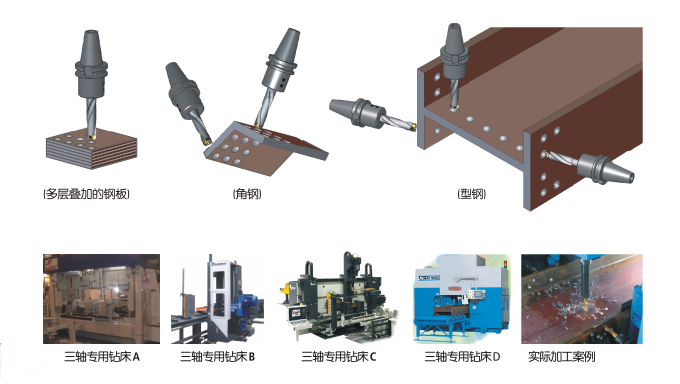
(2) Cost savings
Manufacturers of replaceable crown drill bits also generally pride themselves on the low cost of the tool. Because the replaceable crown drill is only made of hard alloy, it is assembled with the steel cutter body and is much cheaper than the overall hard alloy drill. Although the price of the replaceable crown drill bit is more expensive than the high-speed steel drill bit, its cutting performance is much better. Since one cutter body can be adapted to multiple crowns of different sizes, only a small number of cutter bodies need to be purchased.
Mr. Cui Wanxing said that the use of indexable blade drills for drilling is the lowest cost, but its metal removal rate is not comparable to that of the KRUZ-K series of replaceable crown drills, and additional reaming or fine boring is almost always required after drilling. One of the characteristics of the replaceable crown drill is that no additional process is required. When drilling with a solid carbide drill bit, although there may be only one drill bit installed on the machine tool, there needs to be one in the warehouse, another is just removed from the machine tool, and the other is on the way to the processing station... They add up to a lot. However, after using the replaceable drill bit, only some drill tips need to be placed in the drawer, and a new one can be replaced after one is worn.
According to Mr. Cui Wanworth's point of view, a knife body can be replaced with a new crown at least 15 to 20 times according to practical application needs. If the correct clamping and cooling techniques are used (YESTOOL companies recommend internal cooling), each crown can last about 120 minutes when machining steel parts.
different views
Dan Murphy, regional sales manager at REM Sales, believes that replaceable crown bits are a good fill-in tool. He recommend the use of indexable drills for large holes and the use of solid carbide drills for small holes. For a hole diameter between the two, if it is a large batch processing, he may choose a regrindable solid carbide or a welded drill bit. However, for the machining of medium-sized holes, Dan Murphy believes that the replaceable crown drill can provide multiple functions without large investment. Users do not have to worry about re-grinding procedures, when the need for better performance than high-speed steel tools, and the amount of processing is not enough to use the whole or welded carbide drill bit, can replace the crown bit just can make up for this vacancy. Dan Murphy is also willing to apply the replaceable crown drill bit to the CNC Swiss machine tool with strict hole processing size requirements, because this drill bit can change the cutter head as many times as needed, which can shorten the downtime.
However, Kirk Gordon of Gordon Engineering, a supplier of CNC drill bit grinders, inspection systems and user equipment, has a different view on interchangeable crown bits. According to his point of view, the carbide drill tip requires high rigidity when drilling, and the rigidity of the steel cutter body is insufficient, which is like installing a high-horsepower engine in an economical car. High-performance drill tips require high-strength and high-rigidity tool body support, centering and drive. Gordon is also skeptical about the advertised savings in machining with interchangeable crown bits. He agrees that the use of such drills may theoretically save money, but he believes that the actual cost per cutting edge of a replaceable crown drill may be higher than that of a regrindable solid carbide tool. He also believes that interchangeable crown drills are not as effective as solid carbide drills. For example, in some cases, small differences in geometric dimensions will affect tool performance. In addition, he pointed out that standard replaceable crown drills are usually not suitable for drilling holes with a diameter of less than 1/4 "(6.35mm), thus limiting their application range.
Kirk Gordon believes that, in general, interchangeable crown bits do not seem to make much sense compared to solid carbide bits. Gordon lists the cost of purchasing a replaceable crown bit, the cost of replacing the old cutter body, the cost of replacing (rather than regrinding) the crown, and the cost of reducing the speed and accuracy (hole position, straightness, roundness and dimensional accuracy). According to him, the best use of an exchangeable crown drill is for beginners. These novices may not yet have the ability to replace the entire tool, but can replace the crown. Nevertheless, the operator still needs to keep the front end of the knife body clean and pay attention to observe its wear or damage.
Mr. Murphy of REM Sales disagrees with this conclusion. The main problem, he says, is that people hate throwing things away, and people don't like to learn new things. Buying more expensive tools to eliminate worry is a negative solution. As an alternative, the operator can enter the macro program of the replaceable crown drill into the CNC machining program of the machine tool and discard the cutter body after replacing the crown the appropriate number of times. He believes that the replaceable crown drill is more suitable for machining holes with a depth of 3 to 5 times the diameter, while the overall carbide drill is more suitable for deep hole drilling. The replaceable crown drill is not a "panacea for all diseases". Its main processing objects are holes with soft materials, small and medium batches and relatively shallow depth. For such processing, the replaceable crown drill can play a very good role. In addition, if a group of workpieces have holes of various sizes, the replaceable crown drill bit is used, and the cutter body can cover the appropriate size range, so only the cutter head needs to be replaced. The whole carbide drill is more suitable for processing harder materials, deep holes and for high-volume professional production; while the high-speed steel drill is suitable for one-time use or processing prototype workpieces.
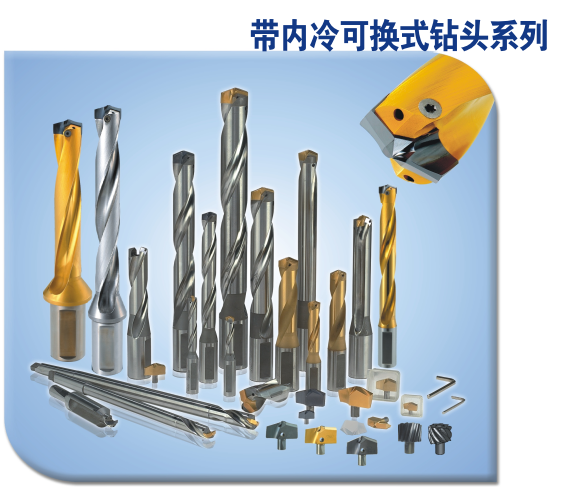


Related News
New Da'an

Follow us
Nanjing Arrow-Stone Industry Co. ,Ltd
Telephone: 86 025 84958290
Address: No. 105, Building 8, District 8, Lingxin Market, Jiangning District, Nanjing